
Switzerland’s Transparency Register starts 1 October 2026. Learn UBO rules, deadlines and what Swiss AGs, GmbHs and foreign owners must do.
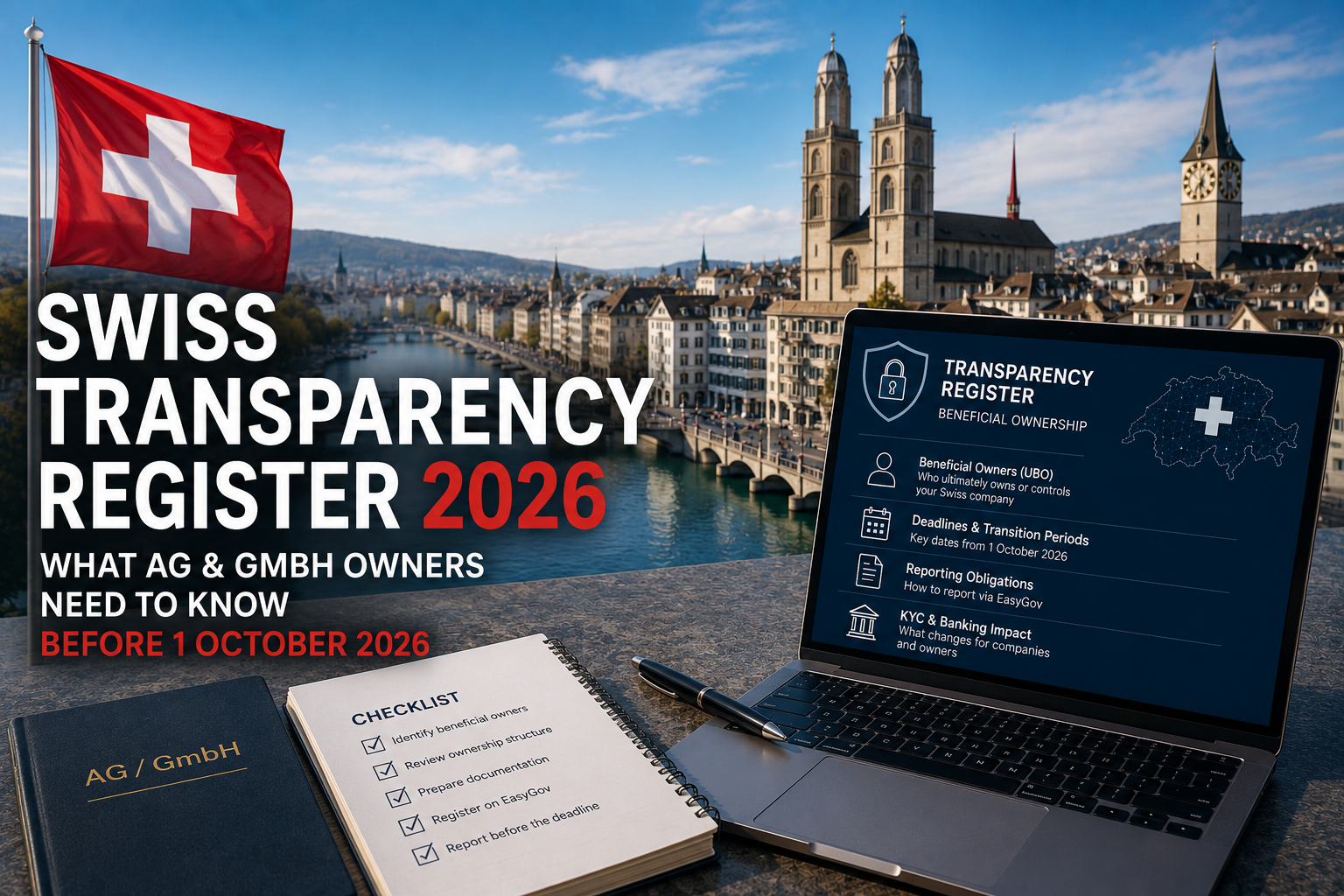
Important: Switzerland's new Transparency Register enters into force on 1 October 2026. This is the date on which the new legal framework becomes effective and the transitional reporting periods begin. It is not a universal filing deadline requiring every existing Swiss AG or GmbH to register by 1 October 2026.
The new regime introduces a central federal register identifying the natural persons who ultimately control many Swiss legal entities. It will affect a large proportion of Swiss Aktiengesellschaften (AGs) and Gesellschaften mit beschränkter Haftung (GmbHs), as well as certain other Swiss and foreign legal entities with a connection to Switzerland.
For international entrepreneurs, foreign shareholders, company owners and purchasers of existing Swiss companies, the practical significance extends beyond registration itself. Beneficial ownership information will increasingly need to remain consistent across corporate records, the Swiss Transparency Register, Commercial Register filings and bank KYC documentation.
Key facts about the Swiss Transparency Register 2026
When does the new law enter into force? 1 October 2026.
What is the register called? Swiss Transparency Register, also referred to as TranspaReg.
Who operates it? The Federal Office of Justice (FOJ / Bundesamt für Justiz).
Is the register public? No. It is not a public beneficial ownership database.
Are Swiss AGs affected? Generally yes, unless a statutory exemption applies.
Are Swiss GmbHs affected? Generally yes, unless a statutory exemption applies.
What is the main UBO threshold? At least 25% of the company's capital or voting rights, or control exercised by other means.
Are indirect owners relevant? Yes. Ownership and control may have to be traced through intermediate companies, holding structures and other legal arrangements.
How quickly must a newly registered company report? Generally within one month after registration in the Commercial Register.
How quickly must later changes be reported? Generally within one month after the company becomes aware of the change.
How do companies report? Primarily electronically through EasyGov.swiss.
Can violations lead to penalties? Yes. Intentional violations of certain reporting and information obligations can result in fines of up to CHF 500,000.
The Federal Council confirmed on 12 June 2026 that the new Federal Act on the Transparency of Legal Entities and the Identification of Beneficial Owners, together with the revised Anti-Money Laundering framework, will enter into force on 1 October 2026.
What is the Swiss Transparency Register?
The Swiss Transparency Register is a new central federal register containing information about the natural persons who ultimately control legal entities subject to the new transparency legislation.
The register is operated by the Federal Office of Justice (FOJ / Bundesamt für Justiz). A control authority within the Federal Department of Finance is responsible for checks concerning the accuracy, completeness and currency of registered information.
The objective is to make beneficial ownership information more readily available to authorised authorities and other legally entitled users in connection with the prevention of money laundering, financial crime, terrorist financing and sanctions enforcement.
The reform also brings Switzerland further into line with international standards developed by the Financial Action Task Force (FATF/GAFI).
The central legal basis is the Federal Act on the Transparency of Legal Entities and the Identification of Beneficial Owners, generally referred to in German as the TJPG. The implementing ordinance is the TJPV.
Is the Swiss beneficial ownership register public?
No.
This is an important distinction between Switzerland and some other jurisdictions.
The Swiss Transparency Register is not a public register. Members of the public, competitors, customers or journalists will not simply be able to search the database and identify the beneficial owners of a Swiss company.
Access is reserved for the control authority, specified public authorities, financial intermediaries and certain advisers covered by the relevant legislation. Access may only be used for legally defined purposes.
The new system therefore increases regulatory transparency without transforming Swiss corporate ownership information into an unrestricted public database.
Which Swiss companies must report their beneficial owners?
The new regime applies to a broad range of Swiss legal entities.
Entities generally subject to the reporting regime include:
- Swiss Aktiengesellschaften (AGs)
- Swiss GmbHs
- Cooperatives
- Partnerships limited by shares
- SICAVs
- SICAFs
- Limited partnerships for collective investment
Certain foreign legal entities may also fall within the regime where they have a sufficiently strong connection to Switzerland.
This can include foreign legal entities that:
- have a branch registered in the Swiss Commercial Register;
- have their effective administration in Switzerland; or
- own or acquire Swiss real estate in circumstances covered by the legislation.
This is therefore not only a Swiss-shareholder issue.
A Swiss AG or GmbH owned by individuals or companies outside Switzerland can still be fully subject to the new rules.
Which entities are exempt?
The legislation contains exemptions, including certain:
- listed companies and qualifying subsidiaries;
- supervised occupational pension institutions; and
- entities substantially controlled by public bodies.
Sole proprietorships, general partnerships, limited partnerships, foundations and associations are also outside the principal reporting regime described above.
Whether a particular legal entity qualifies for an exemption should be assessed based on its actual legal form and ownership structure rather than assumed from its business activity.
Who is considered a beneficial owner or UBO in Switzerland?
For the purposes of the Swiss Transparency Register, the beneficial owner must ultimately be a natural person.
As a general rule, a natural person is considered to exercise relevant control where that person directly or indirectly holds at least 25% of the company's capital or voting rights.
However, ownership percentage is not the only test.
A person can also qualify as a beneficial owner where they exercise control by other means, including certain contractual or governance arrangements.
Control may also exist indirectly through other companies, legal entities, organisations or trusts, or be exercised jointly with other persons.
Example: indirect foreign ownership
Assume a Swiss AG is 100% owned by a foreign holding company.
The foreign holding company itself is not the final beneficial owner simply because it owns the Swiss shares.
The ownership chain must be examined until the relevant natural person or persons exercising ultimate control are identified.
For international company structures, this can therefore require analysis across several jurisdictions and multiple corporate layers.
The Federal Office of Justice has published additional beneficial-owner examples addressing direct, indirect and mixed control structures.
What if nobody owns 25% of the company?
The 25% threshold should not be interpreted as a simple exemption.
A company must also consider whether a natural person controls it through other means.
Where no natural person can ultimately be identified under the applicable control tests, the legislation provides a subsidiary mechanism involving the highest-ranking member of the governing body.
This makes the analysis particularly important for companies with:
- dispersed ownership;
- shareholder agreements;
- special voting rights;
- holding companies;
- trusts; or
- other non-standard governance arrangements.
What information must companies collect and report?
A company subject to the legislation must first identify its beneficial owners and verify the information with appropriate diligence.
Relevant information includes identifying details such as:
- name;
- first name;
- date of birth;
- nationality;
- municipality and country of residence; and
- the nature and extent of the control exercised.
The obligation therefore goes beyond simply entering a shareholder's name into an online form.
Companies need to understand and document why a particular individual qualifies as a beneficial owner.
They must also keep the relevant beneficial ownership information current.
When must an existing Swiss AG or GmbH register?
This is one of the most important practical points.
1 October 2026 is the date on which the law enters into force. It is not the same filing deadline for every existing company.
The TJPG provides transitional periods for legal entities already in existence when the legislation takes effect.
The applicable period depends primarily on the company's structure, legal form, audit status and whether its beneficial owners are already identifiable from the Commercial Register.
Transitional deadlines for existing companies
Where all relevant beneficial owners already appear in the Commercial Register as shareholders, members or members of the governing body and the statutory conditions are fulfilled, the transition period may be up to two years, potentially until 1 October 2028.
For an AG subject to an ordinary audit, the relevant transition period is generally three months, corresponding approximately to 1 January 2027.
For another covered entity subject to an ordinary audit, the transition period is generally four months, corresponding approximately to 1 February 2027.
For an AG not subject to an ordinary audit, the transition period is generally five months, corresponding approximately to 1 March 2027.
For certain other covered entities falling within the relevant residual category, the transition period may be six months, corresponding approximately to 1 April 2027.
The transitional provisions must, however, be considered together with the separate rules concerning changes in the Commercial Register.
A Commercial Register change can accelerate the deadline
Companies should not automatically assume that they can wait until the end of their normal transitional period.
Under the transitional provisions, an existing legal entity may become required to make its initial beneficial-owner filing within one month following its first relevant Commercial Register amendment after the new law enters into force.
This point can be particularly significant in connection with:
- a change of directors or managing directors;
- a company acquisition;
- a change of registered office;
- amendments to the articles of association;
- changes in signing authority or governance; or
- other transactions requiring a Commercial Register filing.
Companies planning corporate changes after 1 October 2026 should therefore review their Transparency Register position before making the Commercial Register amendment.
What is the deadline for a new Swiss company formed after 1 October 2026?
For a new legal entity becoming subject to the law after it enters into force, the general reporting deadline is one month after registration in the Commercial Register.
This means beneficial ownership preparation should increasingly become part of the incorporation workflow rather than an administrative task considered only after the company is operational.
For international founders, it makes sense to determine the UBO structure at the same time as the legal form, shareholders, Swiss representation, capital contribution and banking arrangements are prepared.
How quickly must later UBO changes be reported?
The Transparency Register is intended to remain current rather than provide only a historical snapshot.
Where information recorded in the register changes, the company generally has one month from becoming aware of the change to report the update.
A share sale, restructuring, inheritance, change in voting rights or alteration of an ownership chain may therefore create a new reporting requirement even where the underlying Swiss company itself has not changed its business activity.
For groups with international shareholders, internal procedures for communicating ownership changes to the Swiss company will therefore become increasingly important.
How will companies report to the Swiss Transparency Register?
Reporting will generally take place electronically through EasyGov.swiss, the Swiss federal government's online platform for businesses.
The Federal Office of Justice recommends preparing access in advance.
Registration involves:
- a personal AGOV login;
- an EasyGov account; and
- linking that account to the relevant company's UID.
The validation process can itself take several days.
In certain legally defined cases, reporting may also be transmitted through the relevant cantonal Commercial Register office where the beneficial owners are already entered there in the required capacity and the report accompanies a Commercial Register filing.
Certain straightforward GmbH and single-shareholder AG structures may also qualify for a simplified reporting procedure where the statutory conditions are satisfied.
Standard registration, amendment and deletion of entries in the Transparency Register are generally free of charge, although certain reminders, orders and register extracts may carry fees.
Can companies prepare before 1 October 2026?
Yes.
Companies do not need to wait until October to prepare.
The Federal Office of Justice recommends that companies:
- review their ownership and control structure;
- document participation chains;
- identify their beneficial owners;
- collect the required information;
- compare existing corporate and KYC documentation; and
- prepare EasyGov access in advance.
A federal pilot programme has also been operating since June 2026 to test the technical infrastructure and processes before the register becomes fully operational.
What does the Transparency Register mean for Swiss AGs?
The effect can be particularly important for a Swiss Aktiengesellschaft (AG) because AG shareholders are generally not publicly visible in the Swiss Commercial Register.
The new register does not make those owners publicly visible.
However, the company itself must be able to establish who ultimately controls it and report the required beneficial ownership information to the federal Transparency Register.
For a straightforward owner-managed AG, the exercise may be relatively simple.
For an AG with:
- corporate shareholders;
- foreign holding companies;
- different share classes;
- shareholder agreements;
- nominees;
- trusts; or
- several levels of ownership,
determining the correct beneficial owners can require substantially more work.
Anyone currently planning an AG should therefore consider beneficial ownership reporting as part of the overall formation structure.
What does the Transparency Register mean for Swiss GmbHs?
A Swiss GmbH is somewhat different because its shareholders are normally already visible in the Commercial Register.
However, this does not automatically eliminate the new Transparency Register obligation.
The legal question remains who ultimately controls the GmbH.
Where all members are natural persons and the reportable beneficial owners correspond to those members holding at least 25% of the capital, a simplified procedure may be available if the additional statutory requirements are met.
A GmbH owned by another company, a foreign holding structure or several interconnected legal entities may require a more detailed beneficial-ownership analysis.
What changes for foreign shareholders and international entrepreneurs?
The new regime is highly relevant to internationally owned Swiss companies.
A foreign shareholder does not avoid reporting merely because they live outside Switzerland.
If the owner is a natural person who meets the applicable control test, that individual may have to be identified as the beneficial owner.
Where the shareholder is a foreign company, the analysis generally continues through the ownership chain until the relevant natural person or persons exercising ultimate control are identified.
For example:
Swiss company → direct shareholder → intermediate holding entities → ultimate natural-person owner → nature and extent of control
This ownership map can also become important during a Swiss bank's KYC process.
How does the new register affect Swiss banking and KYC?
The Swiss Transparency Register does not replace bank KYC.
Swiss banks and other financial intermediaries remain responsible for conducting their own customer due diligence and determining the persons who ultimately own or control a corporate customer.
Banks already assess factors such as:
- ownership structure;
- beneficial owners;
- country of residence;
- nationality;
- business activity;
- source of funds;
- source of wealth; and
- expected transactions.
The new transparency regime adds another regulatory information source that authorised financial intermediaries may be able to access.
This makes consistency increasingly important.
A company should seek to ensure that the following information is aligned:
- internal shareholder documentation;
- internal UBO documentation;
- Commercial Register information, where relevant;
- Swiss Transparency Register information;
- bank KYC documentation; and
- group ownership charts.
An inconsistency does not necessarily mean wrongdoing.
Ownership structures change and records may be updated at different times.
However, unexplained discrepancies are likely to create additional questions and documentation requests.
For international entrepreneurs, beneficial ownership should therefore be considered together with banking rather than treated as a completely separate compliance exercise.
What does the new law mean when buying an existing Swiss company?
The Transparency Register is particularly relevant when purchasing an existing Swiss AG or GmbH.
An acquisition often changes shareholders, beneficial owners, governing bodies and bank KYC information at approximately the same time.
From 1 October 2026, due diligence on an existing company should therefore also consider its position under the TJPG.
A buyer should establish:
- whether the company's beneficial owners have been correctly identified;
- whether an initial TranspaReg filing has already been made;
- whether the registered information remains current;
- whether a pending ownership transfer creates a new reporting obligation;
- whether a Commercial Register change accelerates the reporting deadline; and
- whether the ownership information is consistent with the documentation that will be presented to the bank.
This is another reason why purchasing an existing company should not be treated simply as the purchase of a Commercial Register entry.
Banks continue to conduct their own KYC and compliance assessment following a change of ownership.
An existing banking relationship is therefore not automatically transferred to or accepted for a new beneficial owner.
Who is responsible for making the report?
According to the official TranspaReg guidance, responsibility ultimately rests with the relevant governing body of the company.
The reporting task itself may be delegated to another person within the company or to an authorised third party.
For an internationally managed company, it is advisable to establish clearly who will:
- identify the beneficial owners;
- obtain and verify the supporting information;
- document indirect ownership and control chains;
- maintain the information internally;
- monitor changes in ownership or control;
- submit the initial TranspaReg report; and
- report later changes within the statutory deadline.
Beneficial ownership reporting should therefore become part of ongoing Swiss corporate governance rather than being treated as a one-off filing.
What are the penalties for failing to comply?
The new rules include criminal penalties for certain intentional violations.
Under the TJPG, intentional violations of specified reporting or information obligations, including certain failures to report to the Transparency Register or providing false information to the competent authority, may result in a fine of up to CHF 500,000.
The maximum penalty should not be interpreted as an automatic fine for every administrative error.
The relevant statutory provisions specifically address intentional conduct.
Nevertheless, the level of the possible fine demonstrates that beneficial ownership reporting is intended to be a substantive compliance obligation rather than a voluntary administrative formality.
What should Swiss AG and GmbH owners do before 1 October 2026?
Companies do not need to wait until October to start preparing.
A practical preparation process is:
- Confirm whether the entity is subject to the TJPG.
- Map the complete ownership and control structure, including foreign holding companies and indirect participation.
- Identify every relevant natural-person beneficial owner under the 25% threshold and other-control tests.
- Collect and verify the required beneficial-owner information and supporting evidence.
- Compare the ownership information with Commercial Register records and existing bank KYC documentation.
- Register and validate the company's EasyGov access in advance.
- Determine the company's applicable transition deadline, including whether an upcoming Commercial Register amendment may accelerate it.
- Create an internal process for future ownership and control changes so that the one-month updating deadline is not missed.
Alpine Capital perspective: transparency should be integrated into the company structure
For most straightforward Swiss companies, the new Transparency Register should be manageable with appropriate preparation.
The greater challenge is likely to arise where several processes intersect:
foreign ownership + Swiss company formation + beneficial ownership + Commercial Register + resident management + banking/KYC + later ownership changes
These elements should be designed and documented consistently.
Alpine Capital supports Swiss and international entrepreneurs in coordinating company formation, ownership structures, corporate banking preparation, Swiss representation and corporate changes through one central process.
Where specialist legal or notarial implementation is required, the relevant Swiss professionals can be integrated into the mandate.
For new structures, beneficial ownership should be addressed at formation rather than reconstructed afterwards.
For existing companies, the period before the new regime becomes operational provides an opportunity to review whether corporate, ownership and bank KYC records already tell the same story.
For acquisitions of existing Swiss AGs or GmbHs, TranspaReg compliance should form part of the ownership-transfer and due-diligence process.
Frequently Asked Questions about the Swiss Transparency Register 2026
Does every Swiss AG and GmbH have to register by 1 October 2026?
No.
The law enters into force on 1 October 2026, but existing entities benefit from statutory transitional periods.
Depending on the company, these periods can range from several months to up to two years.
A relevant Commercial Register amendment after the new law enters into force can, however, accelerate the filing requirement.
Is the Swiss Transparency Register public?
No.
The register is not publicly searchable.
Access is restricted to specified authorities, financial intermediaries and other authorised users for legally defined purposes.
What percentage makes someone a beneficial owner in Switzerland?
A natural person who directly or indirectly holds at least 25% of the capital or voting rights generally meets the principal participation threshold.
A person can also qualify through control exercised by other means.
Does exactly 25% count?
Yes.
The official rule refers to at least 25%, not more than 25%.
Do foreign beneficial owners have to be reported?
Yes, where they meet the applicable beneficial-ownership or control criteria.
The fact that the natural person resides outside Switzerland does not in itself remove the Swiss company's reporting obligation.
What if a Swiss AG is owned by a foreign company?
The analysis generally continues through the foreign corporate shareholder until the natural person or persons who ultimately exercise relevant control are identified.
Does TranspaReg replace a bank's UBO identification?
No.
Banks and other financial intermediaries remain subject to their own KYC and anti-money-laundering obligations.
The Transparency Register is an additional regulatory source, not a substitute for bank due diligence.
How quickly must a newly incorporated Swiss AG or GmbH report?
A newly subject company will generally have to report its beneficial owners within one month after Commercial Register registration.
How quickly must changes to beneficial ownership be reported?
Relevant changes generally have to be reported within one month after the company becomes aware of them.
Can an adviser submit the report for a company?
Yes.
The filing can be carried out by an authorised person or third party, although responsibility at company level remains relevant.
Where will companies submit the report?
The principal digital route will be EasyGov.swiss, using the Swiss federal online infrastructure and AGOV login.
In certain statutory circumstances, the report may also be transmitted through a cantonal Commercial Register office.
Can a Swiss company prepare already?
Yes.
Companies can prepare EasyGov access and review their ownership and control structures before 1 October 2026.
Official Swiss sources
This article is based on official Swiss federal sources.
Swiss Federal Council – entry into force of the new rules https://www.eid.admin.ch/en/newnsb/x3sKLxCJ6S3dQJtfvy0Tb
Swiss Transparency Register – TranspaReg, Federal Office of Justice https://www.transpareg.admin.ch/
Who must report https://www.transpareg.admin.ch/de/wer-muss-melden
Definition of the beneficial owner https://www.transpareg.admin.ch/de/wer-ist-die-wirtschaftlich-berechtigte-person
Official questions and answers https://www.transpareg.admin.ch/de/fragen-antworten
Legal basis for the Transparency Register https://www.transpareg.admin.ch/de/rechtliche-grundlagen
Official Swiss federal legislation – Fedlex https://www.fedlex.admin.ch/eli/cc/2026/323/de
EasyGov – Swiss federal online platform for businesses https://www.easygov.swiss/
TranspaReg documentation and beneficial-owner examples https://www.transpareg.admin.ch/de/dokumentation
About Alpine Capital
Alpine Capital GmbH is an independent Swiss advisory boutique based in Wollerau, Canton Schwyz.
We support Swiss and international entrepreneurs with company formation, corporate banking preparation, Swiss representation, corporate structuring, company acquisitions and related administrative coordination.
Planning a Swiss AG or GmbH, reviewing an international ownership structure, preparing a Swiss banking relationship or considering the acquisition of an existing Swiss company?
Contact Alpine Capital for a confidential initial discussion.
This article provides general information and does not constitute legal, tax or regulatory advice. The application of the TJPG depends on the specific facts and ownership structure of each entity. Official legislation, ordinances and Federal Office of Justice guidance should be consulted for the current legal position.