Swiss corporate tax rates in 2026 explained: municipality comparisons, all 26 cantons, and why 8.5% is not your company’s total tax rate.
“What is the corporate tax rate in Switzerland?”
It sounds like a question that should have a one-line answer. But in Switzerland, the answer starts with another question: where will the company actually be based?
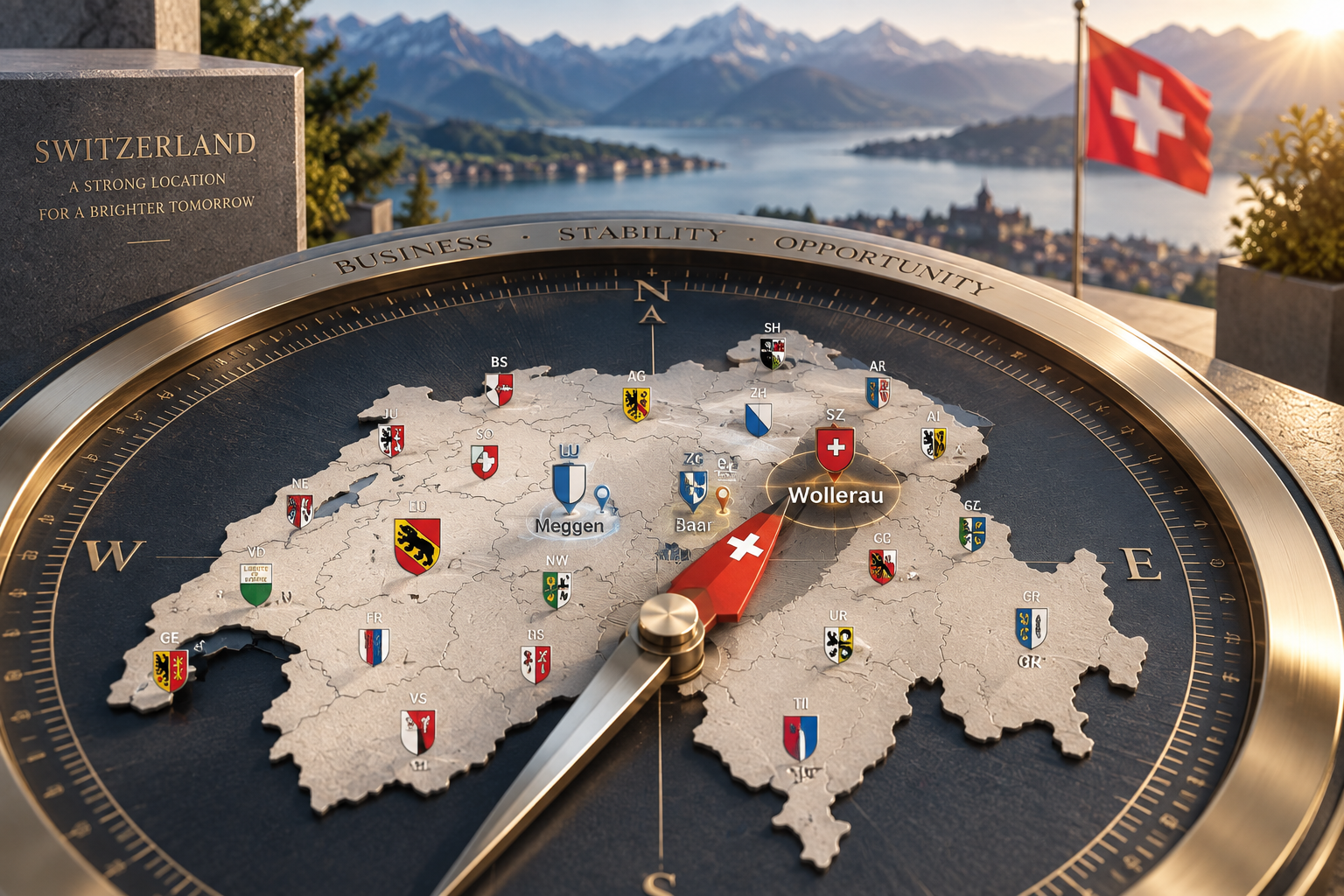
For 2026, an ordinary corporate profit-tax calculation can be around 10.9% in Meggen, 11.6% in Wollerau and 19.47% in the City of Zurich. These are combined rates, not just the local portion of the tax. The difference is substantial enough to matter when choosing where to establish a business.
The local examples are explained below using official municipal tax factors; Zurich’s figure follows the KPMG 2026 cantonal-capital comparison.
So why do some websites mention 8.5%, others around 14%, and others a 15% minimum? They may be describing different things: a federal statutory rate, a combined local rate, a national comparison or rules for large multinational groups.
This guide separates those numbers. It starts with the principle behind Swiss business taxation, then compares actual municipalities before turning to the nationwide canton comparison. The aim is to help foreign entrepreneurs and their advisers understand what the figures mean—and which ones belong in a business plan.
How corporate tax works in Switzerland: one country, several tax levels
A Swiss AG or GmbH does not normally pay one uniform national corporate income-tax rate. Its ordinary profit-tax burden combines federal, cantonal and municipal taxation, with additional local components, such as district or church taxes, where applicable.
The federal statutory profit-tax rate is 8.5%. The cantonal and municipal components depend on the company’s location. That is why selecting a canton is only part of the decision: two municipalities within the same canton can produce different calculations.
The Swiss SME Portal’s explanation of corporate taxation describes these different levels and the distinction between taxes on company profits and taxes on company capital.
Why is the system organised this way?
The explanation lies in Swiss federalism. Cantons developed their own tax systems, and the creation of the modern federal state in 1848 did not replace them with a single nationwide system. Customs revenue became a federal responsibility, while direct taxation became increasingly important to cantonal finances.
Modern harmonisation has aligned important aspects of cantonal direct-tax law without creating one uniform corporate tax rate. The historical background is explained in the Federal Tax Administration’s publication, The Swiss Tax System.
Switzerland is not alone in having location-dependent business taxes. In the United States, businesses can face federal, state and local tax obligations. In Germany, municipal trade-tax rates vary by location.
The practical lesson for Switzerland is straightforward: compare the canton and the municipality—not just the country.
Swiss corporate tax rates by municipality in 2026
For a business choosing premises, management arrangements or a registered office, municipality-level figures are often more useful than a national canton chart.
The following are selected local examples, not a ranking of every Swiss municipality. They illustrate ordinary combined corporate profit tax as a percentage of profit before tax, allowing for tax deductibility.
Selected municipality-level examples
- Meggen, Lucerne — approximately 10.9%.
- Wollerau, Schwyz — approximately 11.6%.
- Baar, Zug — approximately 11.6%.
- Freienbach, including Pfäffikon SZ — approximately 11.6%.
- City of Lucerne — approximately 11.66%.
- City of Zug — approximately 11.71%.
- Steinhausen, Zug — approximately 11.8%.
- Cham, Zug — approximately 11.8%.
The calculations use the published corporate tax factors for Lucerne in 2026, Schwyz in 2026 and Zug in 2026, together with the relevant basic profit-tax rates and federal taxation.
These are rounded orientation figures for ordinary companies. They exclude special tax relief, capital or minimum-tax effects, shareholder-level taxation and any applicable international top-up tax. An actual calculation should use the exact business location, profit, capital and tax circumstances.
What the local comparison reveals
Meggen is not the City of Lucerne. Both are in Canton Lucerne, but the published corporate tax factors differ. A figure labelled simply “Lucerne” may therefore describe the cantonal capital rather than the municipality being considered for the business.
Wollerau is not the municipality of Schwyz. A company in Wollerau should not automatically be modelled using the Schwyz cantonal-capital benchmark. The official Schwyz schedule also distinguishes local tax and church-parish combinations, which makes the precise address relevant.
Baar, Zug, Steinhausen and Cham are not interchangeable. They share a cantonal framework but have different municipal and other local components. At one decimal place, some locations look almost identical; an individual calculation can reveal smaller differences.
That is the first useful correction to a Swiss company-location search: the name of the canton does not always give you the rate for the town.
Wollerau versus Schwyz: why both tax figures can be correct
A reader can encounter a corporate tax figure of approximately 11.6% for Wollerau and a higher figure for Schwyz without either source necessarily being wrong.
The key is to check whether “Schwyz” means the canton as a whole or the municipality used for a national comparison.
For Wollerau, the official 2026 schedule shows a total corporate multiplier of 237% of the simple cantonal tax. That includes the applicable cantonal, district, municipal and church components. Schwyz’s ordinary basic profit-tax rate is 1.95%.
Combining those inputs with federal taxation and allowing for tax deductibility produces approximately 11.60% effective profit tax on profit before tax.
The underlying rules and figures can be checked in Schwyz’s corporate tax guidance and the official 2026 local tax-factor schedule.
This is not a special rate negotiated for foreign owners, and it does not require describing Wollerau as Switzerland’s cheapest municipality. It is a local ordinary-tax calculation.
What the difference means in francs
Consider a simplified company with CHF 1 million of profit before tax, assuming the profit is taxable at the location being compared and no other adjustments apply.
Using the rounded local examples above and Zurich’s published benchmark:
- Meggen, at approximately 10.9%: about CHF 109,000 in profit tax.
- Wollerau, at approximately 11.6%: about CHF 116,000.
- City of Zurich, at 19.47%: about CHF 194,700.
The illustrative difference between Wollerau and Zurich is approximately CHF 78,700 a year.
This is a tax-only comparison, not a promise of savings from changing an address. Staffing, premises, management, the allocation of taxable profit and the cost of operating in each location still need to fit the business.
Swiss corporate tax rates by canton in 2026: all 26 benchmarks
Once the municipality-level distinction is clear, the nationwide comparison becomes much easier to use.
The figures below follow KPMG’s 2026 maximum effective ordinary profit-tax comparison for the relevant cantonal capitals, including federal, cantonal and municipal taxes. They are not average rates across all municipalities within each canton.
Below 13%
- Lucerne — 11.66%
- Zug — 11.71%
- Nidwalden — 11.97%
- Glarus — 12.50%
- Uri — 12.64%
- Appenzell Innerrhoden — 12.66%
- Obwalden — 12.74%
From 13% to below 14%
- Appenzell Ausserrhoden — 13.04%
- Thurgau — 13.21%
- Schwyz — 13.30%
- Basel-Landschaft — 13.45%
From 14% to below 15%
- Fribourg — 14.12%
- St. Gallen — 14.29%
- Basel-Stadt — 14.53%
- Geneva — 14.70%
- Aargau — 14.71%
- Vaud — 14.72%
- Graubünden / Grisons — 14.77%
- Neuchâtel — 14.89%
15% and above
- Schaffhausen — 15.08%
- Solothurn — 15.45%
- Jura — 15.80%
- Ticino — 16.05%
- Valais — 17.12%
- Zurich — 19.47%
- Bern — 20.54%
Source: KPMG, Clarity on Swiss Taxes 2026, corporate-tax comparison and footnotes.
Publication qualification: KPMG’s 2026 chart uses 2025 corporate multipliers for Fribourg and Solothurn. Profit-dependent bands also require separate attention.
What is the average corporate tax rate in Switzerland?
KPMG reports an average of 14.43% for its 2026 comparison, against 14.40% in 2025.
That is a useful national reference, but it is not a rate a company can elect to pay. Nor does it establish the average tax actually paid by Swiss businesses after their individual deductions and adjustments.
The published average and year-on-year context are available in KPMG’s May 2026 tax report announcement.
For a business plan, use the selected municipality and the company’s circumstances—not the national average.
Is Swiss corporate tax really only 8.5%?
No. The 8.5% figure is the federal statutory corporate profit-tax rate, not the complete Swiss corporate tax burden.
There is a second detail behind this figure: corporate income taxes are deductible when determining taxable profit. Consequently, a statutory percentage applied to profit after the tax deduction is not the same as an effective percentage of profit before tax.
Looking at federal tax alone, 8.5% corresponds mathematically to approximately 7.83% of profit before that tax. This isolated calculation is not the total Swiss rate; cantonal and local taxes still have to be considered.
The distinction between the statutory federal rate and tax deductibility is explained in the Federal Tax Administration’s Swiss Tax System publication.
A practical calculation using Wollerau
For the simplified ordinary Wollerau example:
- Cantonal and local nominal component: 1.95% × 2.37 = 4.6215%.
- Combined nominal component: 8.5% + 4.6215% = 13.1215%.
- Effective rate after allowing for deductibility: 13.1215 ÷ 113.1215 × 100 = approximately 11.60%.
This assumes the relevant taxes share the same underlying profit base, without additional adjustments or capital/minimum-tax effects. The inputs come from Schwyz’s corporate tax rules and its 2026 tax factors.
The point to remember is simpler than the calculation:
Do not add another 8.5% to a rate already described as combined effective Swiss corporate tax. Federal tax is already included.
Why different websites show different Swiss tax rates
Two published figures can differ because they answer different questions—not necessarily because one is inaccurate.
One may use the cantonal capital while another uses a different municipality. One may show a maximum rate while another models a particular profit amount. They may also use different years, include different tax components or assume eligibility for relief.
For example, KPMG’s 2026 commentary explains Basel-Stadt’s distinction between a 13.04% rate and the higher 14.53% rate applying to profits above CHF 50 million. Applying the higher headline figure indiscriminately to a much smaller company would obscure that distinction.
Other cantons also have profit-sensitive tariffs. A maximum-rate comparison is therefore not always the same as the effective average burden on a company’s actual profit.
PwC’s tax comparison methodology likewise identifies the cantonal capitals as its Swiss reference locations and distinguishes ordinary corporate rates from OECD minimum-tax rules.
Before comparing two percentages, ask:
- Same year and municipality?
- Same profit level and calculation basis?
- Same taxes included?
- Ordinary taxation or a special assumption?
Those checks are more useful than collecting the lowest percentage from each website.
What a corporate profit-tax rate does not tell you
A profit-tax percentage is important, but it is not the company’s complete tax or operating-cost budget.
Profit tax is not a tax on turnover
A business with CHF 1 million of sales does not automatically pay the quoted profit-tax percentage on CHF 1 million. The relevant figure is taxable profit, after permitted business expenses and tax adjustments.
Accounting profit and taxable profit can also differ. For example, an expense booked in the accounts is not necessarily deductible for tax purposes. The Swiss SME Portal explains the treatment of commercially unjustified expenses and other adjustments.
This distinction matters when comparing a high-turnover trading business with a high-margin consultancy: the same sales figure can produce very different taxable profits.
Capital and minimum taxes require a separate check
Depending on the canton, capital tax or a minimum tax can remain relevant, including when profit is low or absent. Some systems credit or offset amounts against profit tax rather than simply adding two full charges together.
For example, Schwyz’s rules provide for a capital-based minimum tax instead of profit tax when it produces the higher amount.
A loss-making start-up therefore needs a different budget from an established profitable company. “No profit tax” does not necessarily mean “no tax payment or filing obligation”.
Company taxation and owner taxation are different calculations
The corporate rate does not describe how much an owner ultimately retains after receiving salary or dividends. Shareholder residence, distributions and the relevant cross-border rules require a separate assessment.
VAT, employment-related contributions and any transaction-specific taxes are also outside this ordinary profit-tax comparison. The Federal Tax Administration’s overview of the Swiss tax system distinguishes these separate tax categories.
A company-location comparison should not be used as a personal relocation tax calculation.
Does the 15% minimum tax apply to every Swiss company?
No. Switzerland’s implementation of the OECD minimum-tax framework does not impose a universal 15% corporate rate on every AG or GmbH.
The rules concern qualifying multinational groups, generally with consolidated annual revenue of at least EUR 750 million. A Swiss entity within such a group needs a separate analysis even when its own local turnover is modest.
For an ordinary independent business outside that framework, a combined local rate below 15% can still apply.
There is another important distinction: the international minimum-tax framework uses its own calculation rules. It is not simply a case of replacing every municipal percentage below 15% with 15%.
The scope and Swiss implementation are explained by the Federal Department of Finance, with current administrative material available from the Federal Tax Administration’s top-up tax pages.
Can deductions or relief change the result?
Yes. Ordinary-rate comparisons deliberately leave out company-specific relief.
Depending on eligibility and the applicable rules, participation relief, patent-box treatment, research-and-development deductions or other adjustments can change the tax result. These should be assessed against the company’s actual income, functions and expenditure—not assumed merely because it has a Swiss registration.
For example, Lucerne’s tax authority publishes separate guidance on participation companies and corporate tax matters, including the distinction between current rules and historical holding-company regimes.
For a conventional trading or consulting business, the ordinary local rate is usually the appropriate starting point for a comparison. For a business with substantial qualifying participation income or intellectual property, the analysis needs to go further.
An available relief is not the same thing as an automatic entitlement.
How to calculate Swiss corporate tax for your own company
The practical next step is a municipality-specific calculation using the Swiss Federal Tax Administration’s tax calculator or the relevant cantonal calculator.
Prepare the tax year, legal form, exact location, expected profit and taxable capital. Also identify anything that makes the company different from a simple single-location business: operations in another canton, foreign establishments, participation income or special relief.
Pay particular attention to whether a calculator requests profit before tax or profit after tax. The distinction changes the input. For example, Zug’s corporate tax calculator guidance explicitly offers separate calculation approaches.
When comparing locations, keep the assumptions consistent. Using pre-tax profit for one calculation and post-tax profit for another will not produce a meaningful comparison.
A calculator is a planning tool, not a binding tax ruling. Where the allocation of profit, residence or treatment of a transaction is material, those questions should be resolved before relying on the output.
Choosing a Swiss business location: beyond the lowest percentage
Tax deserves a place in the location decision, but it should be translated into annual francs and considered alongside the business itself.
A difference of one percentage point represents CHF 1,000 on CHF 100,000 of profit, but CHF 10,000 on CHF 1 million. The importance of the same rate difference changes as the company becomes more profitable.
Compare that amount with the cost of suitable premises, recruitment, management, administration and access to customers. A location with a slightly higher tax rate may still produce a lower total operating cost. Conversely, a location difference that appears small in a percentage chart can be material for a consistently profitable business.
The address must match the facts
The tax analysis is not determined solely by where a nameplate is installed. Swiss rules recognise factors such as the statutory seat, effective management and taxable establishments. Schwyz’s guidance expressly identifies the registered seat or place of actual management in its explanation of the place of taxation.
For an international structure, this means the Swiss location decision should be coordinated with the people who manage the company, its premises and its activities. Operations outside Switzerland can also require analysis under the relevant foreign rules and tax treaty.
The useful question is therefore not simply “Which Swiss canton has the lowest corporate tax?” It is:
Which location gives this business a workable operating structure and an accurately calculated tax position?
Frequently asked questions about Swiss corporate taxation
Is the corporate tax rate the same everywhere within a Swiss canton?
Not necessarily. Municipal and other local components can differ. The official Schwyz tax-factor schedule, for example, contains different corporate multipliers for different locations within the canton.
Should I use a cantonal average to budget for company tax?
Use a calculation for the actual municipality instead. A published cantonal-capital benchmark is not an average across that canton’s municipalities. PwC explains this geographical basis in its comparison methodology.
Are Swiss GmbH and AG tax rates different?
For ordinary corporate profit taxation, an AG and a GmbH in the same location are generally subject to the same framework. The legal form should not be chosen on the assumption that one automatically receives a lower ordinary tax rate. See the Swiss SME Portal’s corporate-tax overview.
Is Zug automatically the lowest-tax location for a Swiss company?
The answer requires a defined comparison. A chart of cantonal capitals does not establish the lowest-tax municipality nationwide, and Zug’s own municipalities have different corporate factors. The Canton Zug’s official schedule allows those local differences to be checked.
Does a company with no profit have no Swiss tax costs?
Not necessarily. Capital-based or minimum taxes can still be relevant, and ongoing administration must be budgeted separately. The precise treatment depends on the canton; Schwyz’s minimum-tax rules provide one example.
Where can I check an individual Swiss corporate tax calculation?
Start with the Federal Tax Administration’s tax calculator. For a specific company, confirm the correct tax year, municipality, profit definition and capital assumptions, and check matters that require an individual assessment.
Sources, scope and how to use this guide
This guide combines two different types of information: municipal calculations based on official local tax factors, and a consistently defined national comparison based on KPMG’s published cantonal-capital figures.
The local examples are deliberately selective. They are not a claim to have ranked every Swiss municipality. The nationwide figures are benchmarks rather than individual company quotations, and their publication qualifications are retained above.
The principal reference materials are the Federal Tax Administration’s tax-system explanation, the official corporate tax schedules for Lucerne, Schwyz and Zug, and KPMG’s 2026 report.
Figures relate to the 2026 comparison and were reviewed on 25 September 2026. This article provides general information, not an individual tax assessment or a guarantee of the treatment of a proposed structure.
From comparison to implementation
Once suitable locations have been identified, the next step is to align the company’s legal structure, management, banking and ongoing administration with the chosen operating model.
Alpine Capital supports Swiss company formation and implementation, accounting and tax coordination and office arrangements in Wollerau, working with specialist advisers where the circumstances require it.
For a specific establishment, relocation or subsidiary project, contact Alpine Capital with the intended activity, ownership structure and expected Swiss presence.