Swiss AG and GmbH companies are both limited-liability legal entities, but they differ materially in capital, public ownership disclosure, governance and ownership transfers. This 2026 reference guide compares the two structures using current Swiss official sources.
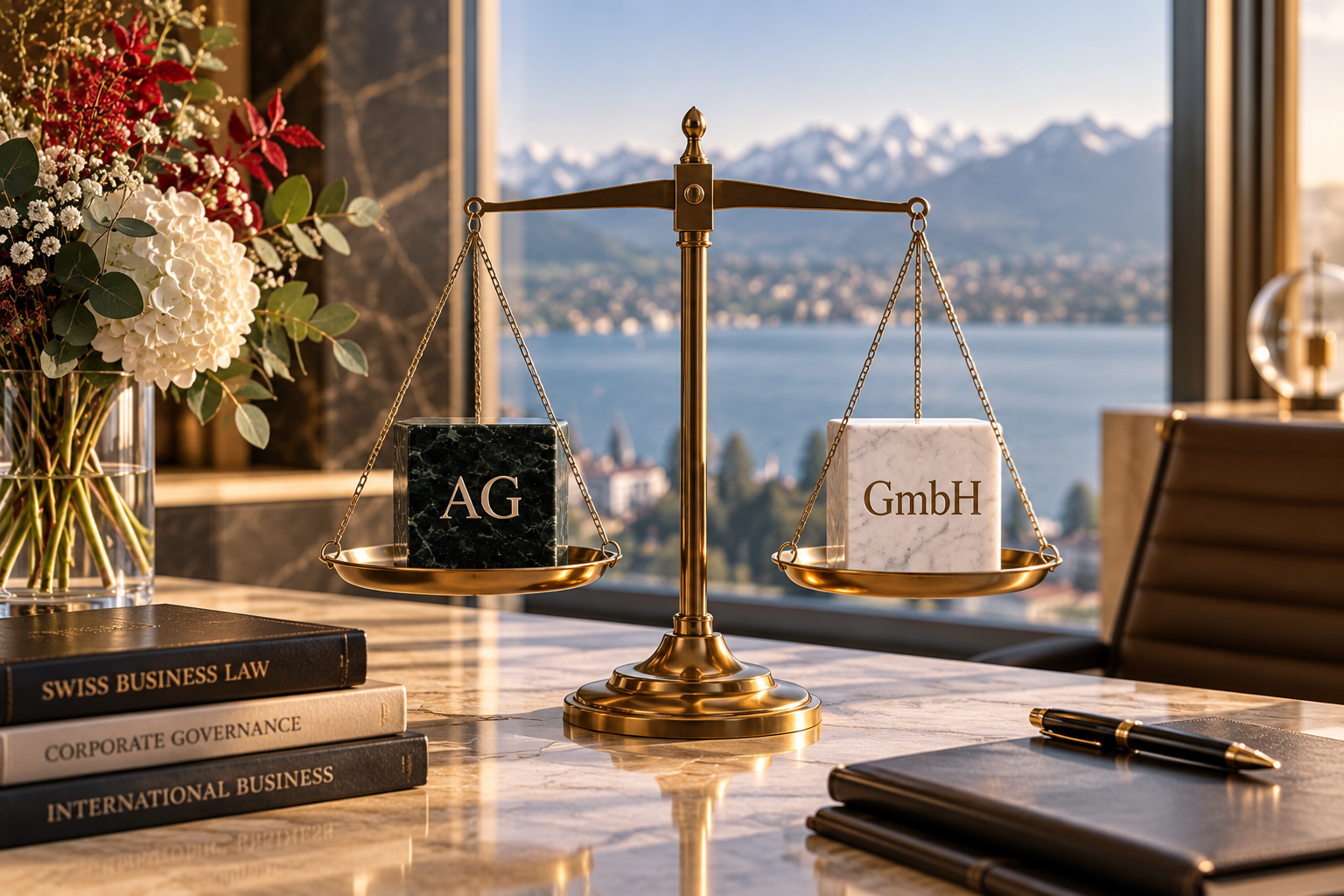
A Swiss AG and a Swiss GmbH are both separate legal entities with limited liability, and both can be used for genuine operating businesses, subsidiaries and international ownership.
The important differences are not primarily about taxation.
They concern capital, public ownership disclosure, governance, ownership transfers and how the company is expected to develop over time.
For founders searching for “Swiss AG vs GmbH”, the shortest useful answer is:
- a GmbH requires CHF 20,000 of fully paid capital and publicly identifies its shareholders in the Swiss Commercial Register
- an AG requires CHF 100,000 of nominal share capital, with at least CHF 50,000 generally paid in, while its shareholders are generally not listed publicly merely because they own shares
- both generally require at least one appropriately authorised representative resident in Switzerland
- both follow the same general Swiss audit framework
- both can generally be owned by foreign individuals or foreign legal entities
- neither legal form automatically produces a more favourable corporate tax result
- neither legal form guarantees a Swiss bank account
The correct legal form should therefore follow the ownership model and commercial purpose of the business.
Information reviewed: 24 September 2026.
Swiss AG vs GmbH: the quick comparison
The main differences can be summarised as follows.
Minimum capital
Swiss GmbH:
- CHF 20,000 minimum share capital
- fully paid at incorporation
Swiss AG:
- CHF 100,000 minimum nominal share capital
- at least 20% of the nominal value of each share must generally be paid
- the total paid-in amount must be at least CHF 50,000
The official Swiss SME Portal confirms these statutory capital requirements for both the Swiss GmbH and the Swiss AG.
Public ownership disclosure
Swiss GmbH:
- members are registered in the Commercial Register
- their registered participations are publicly visible
Swiss AG:
- shareholders are generally not entered in the public Commercial Register merely because they own shares
- board members and authorised signatories remain publicly registered
This difference concerns public disclosure.
It does not mean that an AG provides anonymous ownership.
Governance
Swiss GmbH:
- the shareholders' meeting is the highest corporate body
- management is generally exercised by the shareholders unless the articles provide another arrangement
- managing directors can be appointed
Swiss AG:
- the general meeting is the shareholders' supreme corporate body
- the board of directors carries important statutory and non-transferable governance responsibilities
- operational management can be delegated within the legal framework
Transfer of ownership
Swiss GmbH:
- transfer of quotas must be in writing
- shareholder approval is generally required unless the articles provide otherwise
- changes in membership are reflected in the Commercial Register
Swiss AG:
- shares are generally more easily transferable
- transfer restrictions can nevertheless exist under law, the articles or contractual arrangements
For a company that expects future investors, ownership changes or a wider shareholder base, this distinction can become commercially important.
Capital is not the same thing as formation cost
One of the most common misunderstandings when comparing an AG and GmbH is to treat the statutory capital as a professional fee.
It is not.
The CHF 20,000 of a GmbH or the paid-in capital of an AG is company capital.
During incorporation, the amount is generally deposited into a capital contribution account.
Once the company has been entered in the Commercial Register and the bank completes the release process, the capital becomes available to the company for legitimate corporate purposes, subject to Swiss capital-maintenance rules.
Formation costs are separate.
They can include:
- notary fees
- Commercial Register fees
- document certifications
- translations
- Apostilles where required
- professional advice
- registered-office costs
- banking preparation
- accounting setup
Entrepreneurs who want an initial indication of these separate components can use Alpine Capital's Swiss company formation cost calculator.
The capital requirement should therefore not be described as the “price” of an AG or GmbH.
Is a GmbH cheaper than an AG?
In terms of statutory capital, yes.
The GmbH requires CHF 20,000 fully paid, compared with CHF 100,000 nominal capital for an AG, with at least CHF 50,000 generally paid at incorporation.
The professional and administrative formation costs can also differ.
But cost alone is a weak reason for selecting the legal form.
A company that begins as a GmbH but shortly afterwards needs a different ownership or governance model may create additional restructuring work later.
Conversely, committing AG-level capital where the business has no commercial need for an AG can be equally unnecessary.
The question should be:
What does the company need to look like in two, five or ten years?
Are GmbH owners public?
Yes.
The members of a Swiss GmbH and their registered participations are entered in the Swiss Commercial Register.
This is one of the most important practical differences between a GmbH and an AG.
For owner-managed businesses, family businesses, consultancies and subsidiaries with a stable ownership structure, this public disclosure may be entirely acceptable.
For businesses expecting multiple ownership changes or institutional investors, the public nature of GmbH membership may become more relevant.
For the detailed legal and practical requirements, see Alpine Capital's Swiss GmbH formation overview.
Are AG shareholders anonymous?
No.
This distinction is frequently misunderstood.
The shareholders of a Swiss AG are generally not displayed in the public Commercial Register simply because they own shares.
That is not the same as anonymous ownership.
The company must maintain the legally required ownership records.
Banks and other regulated institutions must identify beneficial owners where applicable.
And from 1 October 2026, Switzerland's new Act on the Transparency of Legal Persons and the Identification of Beneficial Owners enters into force.
The new regime creates a central federal transparency register for the beneficial owners of affected legal entities.
The Federal Office of Justice states that the legislation enters into force on 1 October 2026 and that this date begins the relevant transition periods.
The register is designed for competent authorities and is not a public Companies House-style shareholder database.
Official information is available from the Federal Office of Justice.
The practical conclusion is simple:
An AG provides a different level of public ownership disclosure from a GmbH.
It does not provide secret ownership.
For the AG-specific corporate requirements, see Alpine Capital's Swiss AG formation overview.
Which structure is easier when investors enter?
An AG generally provides greater flexibility where ownership is expected to change repeatedly or where the business plans a broader investor base.
Shares are designed as transferable participation instruments, subject to the applicable statutory and contractual restrictions.
A GmbH is more closely connected to its members.
The transfer of GmbH quotas requires a written agreement and, as a general rule, approval of the shareholders' meeting unless the articles provide differently.
The Swiss SME Portal describes this distinction in its official guidance on AG and GmbH legal forms.
This does not mean every startup should automatically begin as an AG.
It means the expected ownership lifecycle is one of the factors that should be considered before incorporation.
Governance: the difference becomes more important as the company grows
A GmbH is often closely connected to its owners.
Under the general statutory model, the shareholders participate in management unless another structure is established.
This can work well for:
- founder-managed companies
- family businesses
- consultancies
- professional-services businesses
- smaller subsidiaries
- businesses with a stable ownership group
An AG has a board of directors with specific statutory duties.
This can be useful where the company requires:
- a clearer distinction between ownership and governance
- independent board participation
- multiple investors
- institutional oversight
- succession planning
- a wider international group structure
Neither governance model is inherently superior.
They are designed for different ownership and management situations.
Can foreigners own a Swiss AG or GmbH?
Generally, yes.
Foreign individuals and foreign legal entities can generally establish and own Swiss AG and GmbH companies for ordinary commercial activities.
The shareholder does not normally need to be Swiss.
The company does, however, need qualifying Swiss-resident representation.
This is why ownership and representation should always be treated as two separate questions.
For founders living outside Switzerland, Alpine Capital's Swiss company formation for foreigners explains this distinction in more detail.
Does an AG or GmbH need a Swiss resident director?
The precise legal requirement is broader than the expression “Swiss director”.
Both legal forms must be capable of being represented by at least one appropriately authorised person whose place of residence is in Switzerland.
For an AG, that person may be a board member or another authorised representative.
For a GmbH, the requirement can be fulfilled through an appropriately authorised managing person or director.
The Swiss SME Portal confirms the resident-representation requirement for both forms.
For international owners, the role should not be treated as the rental of a signature.
The authority, access to information and governance responsibilities should correspond to the actual mandate.
More detail is available in Alpine Capital's Swiss resident representation guide.
Do AG and GmbH companies have different corporate tax rates?
As a general rule, the choice between AG and GmbH does not create a separate Swiss corporate income-tax regime.
Both are legal entities subject to Swiss corporate taxation.
The Swiss SME Portal expressly notes that the taxation of a GmbH is identical to that of an AG.
The actual corporate tax burden depends instead on factors such as:
- canton
- municipality
- taxable profit
- taxable capital
- applicable tax period
- the company's facts
- any statutory relief for which the company genuinely qualifies
A founder should therefore be cautious about advice suggesting that an AG is inherently more tax-efficient than a GmbH or vice versa.
The legal-form decision should not be presented as a tax scheme.
Are the audit requirements different for AG and GmbH?
Generally, no.
Swiss audit requirements are principally driven by company size and economic importance rather than by choosing AG instead of GmbH.
According to the official Swiss SME Portal, an ordinary audit is generally required when a company exceeds two of the following thresholds in two consecutive financial years:
- CHF 20 million balance-sheet total
- CHF 40 million revenue
- 250 full-time employees
Other statutory situations can also trigger an ordinary audit.
Companies that do not meet the ordinary-audit requirements are generally subject to a restricted audit.
An eligible smaller company may waive the restricted audit if the legal conditions are satisfied, including unanimous owner consent and no more than ten full-time employees on an annual average.
The current rules are explained by the Swiss SME Portal's audit guidance.
The audit question therefore normally does not decide AG versus GmbH.
Does an AG have a better chance of opening a Swiss bank account?
Not automatically.
A Swiss bank does not approve an operating account simply because the applicant is an AG rather than a GmbH.
The bank needs to understand the complete relationship, including:
- shareholders and beneficial owners
- management
- Source of Funds
- Source of Wealth where relevant
- business activity
- customers
- suppliers
- jurisdictions
- currencies
- anticipated transaction volumes
For some institutional businesses, an AG may fit the wider governance model better.
That does not make the legal form itself a banking guarantee.
Company incorporation and bank-account approval remain separate processes.
For international shareholders, see Alpine Capital's overview of Swiss corporate bank accounts for foreign-owned companies.
Does a company need a real Swiss address?
Both an AG and GmbH need a registered Swiss seat and an address that can legally be used by the company.
The amount of physical infrastructure needed beyond this depends on what the company actually does.
A consulting business, international subsidiary, pharmaceutical company and manufacturer will naturally require different operational footprints.
The key principle is consistency.
A registered address is legitimate infrastructure.
It does not by itself establish that management, employees or business functions have moved to Switzerland.
Alpine Capital's registered office and business domicile overview explains the distinction between legal domicile and operating infrastructure.
AG or GmbH for a foreign-owned Swiss subsidiary?
Both forms can work.
The decision commonly depends on:
- group governance
- expected number of shareholders
- future investment
- public ownership disclosure
- transferability of the participation
- capital
- board structure
- the expected role of the Swiss company
For a closely held subsidiary with stable ownership, a GmbH can be entirely appropriate.
For a group expecting ownership changes, outside investment or a more institutional governance model, an AG may fit better.
The answer should follow the planned role of the company rather than nationality alone.
Can a GmbH later become an AG?
Swiss law provides mechanisms for changing legal form.
That means the first legal-form decision does not necessarily need to remain unchanged forever.
But conversion can require corporate approvals, documentation, professional work and sufficient capital.
Choosing the initial structure with a reasonable view of future ownership and governance can therefore avoid unnecessary restructuring.
What does not decide AG versus GmbH?
Several arguments are often given too much weight.
“An AG automatically looks more serious”
The legal form alone does not create credibility.
Customers, banks and investors can assess:
- business history
- employees
- management
- contracts
- financial statements
- regulatory status
- governance
- actual operating activity
An empty AG does not automatically have more commercial substance than an operating GmbH.
“A GmbH is only for very small companies”
A GmbH is widely used by substantial Swiss operating businesses and subsidiaries.
CHF 20,000 is a statutory minimum capital requirement, not a limit on the size of the business.
“An AG hides its owner”
It does not.
AG shareholders generally have a different level of public visibility, but beneficial ownership remains subject to corporate, banking, AML and — from October 2026 — federal transparency requirements.
“One form pays less tax”
There is no general AG-versus-GmbH corporate tax advantage.
Tax depends on the company and its actual circumstances.
Swiss AG vs GmbH: the practical decision framework
Before deciding, a founder should be able to answer at least these questions:
- Who will own the company today?
- Is the ownership likely to change?
- Will external investors enter?
- Is public disclosure of the owners acceptable?
- How much capital should the business have?
- Who will manage the company?
- Is a board structure commercially useful?
- Who will represent the company in Switzerland?
- What does the company actually do in Switzerland?
- What banking activity is expected?
- Is the company intended to remain owner-managed or become more institutional over time?
The answers usually make the AG-versus-GmbH question significantly clearer.
A legal form should follow the business
For many entrepreneurs, the GmbH is an effective operating structure.
For others, the AG better supports the ownership, governance or investment model.
Neither form should be selected because of a slogan such as “more prestigious”, “more private” or “more tax-efficient”.
The useful question is:
Which corporate form best reflects the company that will actually exist?
This principle is especially important for international founders.
A Swiss company should have a coherent ownership structure, appropriate governance, genuine commercial purpose, defensible banking profile and an operating reality that matches what is presented to counterparties and authorities.
For a broader discussion of when Switzerland itself makes economic sense, see When Does a Swiss Company Make Economic and Strategic Sense?.
Alpine Capital perspective
Alpine Capital works with AG and GmbH structures for Swiss and international owners.
Our role is not to promote one legal form universally.
It is to coordinate the company, governance, Swiss representation, registered office, incorporation and banking workstreams so that they describe the same business.
If you are comparing an AG and GmbH for a real Swiss project, the structure should be assessed before the incorporation documents are finalised.
Frequently asked questions
What is the main difference between a Swiss AG and GmbH?
The main differences concern capital, public ownership disclosure, governance and ownership transfers.
A GmbH requires CHF 20,000 fully paid capital and publicly identifies its members.
An AG requires CHF 100,000 nominal share capital, with at least CHF 50,000 generally paid in, and shareholders are generally not publicly listed merely because they own shares.
Which is cheaper: AG or GmbH?
A GmbH has the lower statutory capital requirement.
However, company capital is not the same as incorporation cost.
Professional, notarial, banking and Commercial Register costs are separate.
Which is better for foreign owners?
Both can generally be foreign-owned.
The better fit depends on capital, ownership visibility, governance, future investors and the commercial role of the Swiss company.
Which is better for investors?
An AG can provide greater flexibility for a changing or larger shareholder base.
This does not mean every company planning future growth automatically needs an AG.
Is an AG more tax-efficient than a GmbH?
Not as a general rule.
Both are subject to the same general Swiss corporate-tax framework.
Are AG shareholders secret?
No.
They are generally not publicly listed merely as shareholders, but beneficial ownership must still be transparent to the company, banks and competent authorities under the applicable rules.
Can one person own a Swiss AG or GmbH?
Yes.
Both structures can generally have a single owner, including a legal entity.
Do both structures require Swiss representation?
Yes.
Both must be capable of being represented by at least one appropriately authorised person resident in Switzerland.
Can a foreign company own a Swiss AG or GmbH?
Generally, yes.
A foreign legal entity can generally own a Swiss subsidiary, subject to the nature of the business and any sector-specific restrictions.
Do AG and GmbH companies have the same audit thresholds?
Yes, the general statutory audit thresholds apply independently of choosing AG or GmbH.
Official and Supporting Sources
Information reviewed: 24 September 2026.
Disclaimer
This article provides general information on Swiss corporate forms based on the legal and regulatory position reviewed in September 2026.
It does not constitute legal, tax, banking, investment or regulatory advice.
The appropriate legal form depends on the owners, business activity, capital, governance, financing, intended investors, management, regulatory status and actual Swiss operations.
Corporate tax, shareholder taxation, withholding tax, accounting, audit, banking, beneficial-owner reporting, employment and cross-border consequences should therefore be reviewed according to the individual circumstances before implementation.