
Buying an existing Swiss AG or GmbH can save months — especially when banking or regulatory infrastructure already exists. But hidden liabilities, KYC reviews, ownership changes and regulatory requirements can quickly destroy that advantage. Here is what foreign buyers should check before acquiring a ready-made Swiss company.
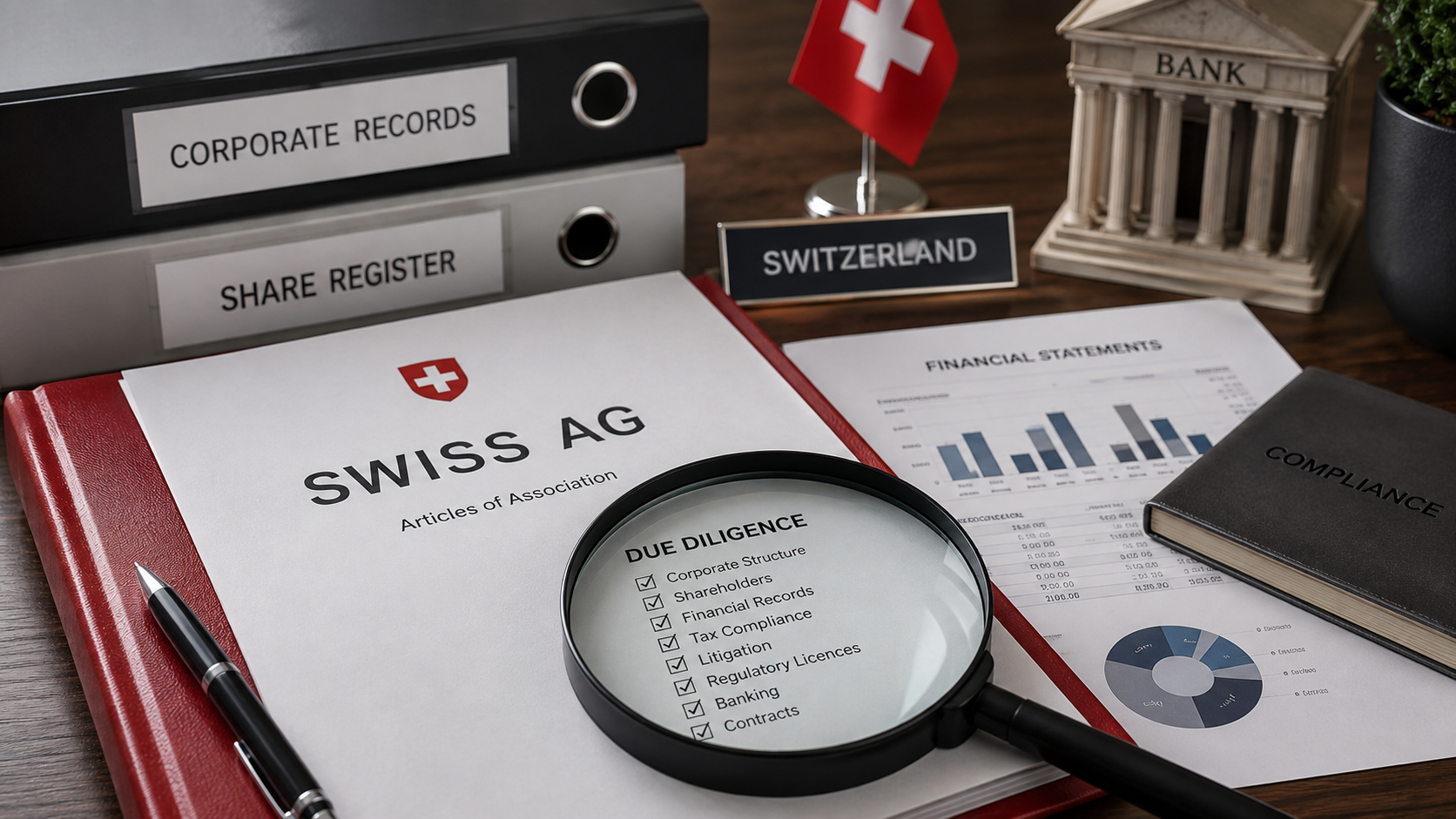
BUYING AN EXISTING SWISS COMPANY: THE REAL RISKS FOREIGN BUYERS SHOULD KNOW
What I would check before acquiring an existing Swiss AG or GmbH — and why company age, speed, an existing Swiss bank account or even an existing regulatory authorisation are not enough.
Buying an existing Swiss company can be an excellent shortcut into Switzerland.
An established Swiss AG or GmbH may already have a company number, registered office, accounting history, VAT registration, contracts, banking relationships and, in some cases, regulatory permissions or memberships that would otherwise take considerable time to establish.
For many international entrepreneurs, this is exactly the attraction.
They do not want to spend months building the infrastructure before becoming operational. They want to acquire an existing Swiss company, complete the ownership change and start doing business as quickly as possible.
In principle, this can make very good commercial sense.
But there is one sentence I repeat to foreign buyers:
You are not buying an incorporation date. You are buying a legal entity with a past.
And if the company is regulated, there is a second sentence I would add:
You are not simply buying a licence. You are buying a company that must continue to deserve that licence after you take control.
After many years of working with Swiss companies, banks, directors and international clients, I have learned that the most expensive problems are rarely visible in the Commercial Register.
They are usually hidden in accounting records, tax history, old contracts, bank compliance files, regulatory obligations, previous transactions or obligations created years before the new owner arrived.
That does not mean that buying an existing Swiss company is dangerous.
It means that buying the wrong company without proper Swiss company due diligence can be dangerous.
- WHY FOREIGN BUYERS WANT EXISTING SWISS COMPANIES: SPEED
One of the strongest arguments for buying an existing Swiss AG or GmbH is speed.
An international entrepreneur may already have investors, customers, suppliers, employees or transactions waiting.
Waiting for a completely new structure can create a commercial problem.
An existing Swiss company may already have:
a Commercial Register entry;
a UID number;
an established corporate history;
accounting infrastructure;
a registered office;
VAT registration;
insurance;
contracts;
banking relationships;
employees or payroll infrastructure;
regulatory memberships or authorisations;
and other elements required to operate a business.
For the right buyer, acquiring this infrastructure can save substantial time.
But this is also where people make one of the most expensive mistakes.
They confuse:
“the company already exists”
with:
“the company is ready for me to operate immediately.”
These are not the same thing.
- THE HIDDEN ROCKS UNDER “READY TO OPERATE”
A foreign buyer may acquire the shares on Monday and believe that the company can simply continue operating on Tuesday.
In reality, several things may happen immediately after an ownership change.
The bank may start a new KYC review.
The existing signatories may have to be changed.
The beneficial owner must be disclosed.
The bank may want to understand the new owner's Source of Funds and Source of Wealth.
The intended new business activity may be different from the historical business.
The company's purpose may require amendment.
A Swiss resident director or authorised representative may need to be appointed.
Existing insurance may not cover the new activity.
Contracts may contain change-of-control provisions.
VAT treatment may change.
Regulatory approvals may have to be obtained before the new business model can continue.
An SRO, supervisory organisation or FINMA may need to be informed about changes.
Employees, outsourcing arrangements, compliance functions or responsible managers may have been essential to an existing regulatory setup.
This means that the real question is not:
“How fast can I buy the shares?”
The better question is:
“How fast can this company legally and practically operate under my ownership and my business model?”
Those are very different timelines.
A company acquisition can be completed quickly while operational readiness still takes weeks or months.
This is one of the first things I want to clarify with a client before recommending an existing Swiss company.
- NOT ALL EXISTING SWISS COMPANIES ARE THE SAME
There is an important difference between the products that are often internationally advertised under terms such as:
“ready-made Swiss company”
“aged Swiss company”
“Swiss shelf company”
“Swiss company with bank account”
“Swiss company with SRO”
“Swiss financial company for sale”
or
“FINMA licensed company for sale.”
A Swiss shelf or ready-made company is normally a company that has been incorporated but ideally has never conducted substantial commercial activity.
Its historical risk may therefore be relatively limited.
But even the statement “never traded” should be verified.
A dormant or aged company — sometimes described as a Mantelgesellschaft — is different.
Such a company may previously have conducted business and later become inactive.
Its historical liabilities, financial situation and reputation therefore require substantially more investigation.
An operating Swiss company has a genuine commercial history, accounting, contracts and potentially employees, customers, banking relationships and liabilities.
Such history can be commercially valuable.
But it requires legal, financial and tax due diligence.
Finally, a regulated or supervised company requires an additional layer of analysis.
Its regulatory status may be one of the most valuable assets being acquired.
It may also be one of the easiest assets to damage if the acquisition is structured incorrectly.
An older Swiss company can therefore be an advantage — but only when its history and current status are transparent and verifiable.
- SOMETIMES THE LICENCE IS WORTH MORE THAN THE COMPANY
This is particularly important in financial services, asset management, crypto-related businesses and precious-metals activities.
A buyer may not primarily be interested in the AG or GmbH itself.
The buyer may be interested because the company already has a particular regulatory setup.
For example, the company may be:
a FINMA-authorised portfolio manager;
a FINMA-authorised trustee;
a manager of collective assets;
a securities firm;
a FinTech-licensed institution;
a bank;
a financial intermediary affiliated with a recognised SRO for AML supervision;
a crypto-related financial intermediary operating within a particular regulatory framework;
or a business holding permissions relevant to precious-metals activities.
In such situations, the regulatory position may have required substantial time, specialist work, compliance infrastructure, qualified personnel and financial resources to establish.
That can make an existing regulated company extremely attractive.
But this is also where buyers must be especially careful.
- A LICENCE IS NOT A PIECE OF FURNITURE THAT AUTOMATICALLY COMES WITH THE COMPANY
Foreign buyers sometimes think about a regulated company in the same way they think about an office building.
The company owns something valuable.
They buy the company.
Therefore, they assume that they automatically own and can use everything exactly as before.
Regulatory authorisations do not work that way.
FINMA makes clear that regulated institutions must continue satisfying their licensing requirements.
For portfolio managers and trustees, for example, significant changes can require prior FINMA approval.
These include changes in:
the persons responsible for management and business operations;
and new owners of qualified participations.
Official FINMA information: https://www.finma.ch/en/authorisation/portfolio-managers-and-trustees/aenderungen/
The same principle exists in other regulated financial businesses.
Changes in the strategic or executive management of banks and securities firms require FINMA authorisation so that the institution can continue its business.
Official FINMA information: https://www.finma.ch/en/authorisation/banks-and-securities-firms/changes-to-licences/licensing-and-authorisation-requirements/changes-in-ultimate-management/
Changes in qualified participations can also trigger reporting or authorisation requirements.
Official FINMA information: https://www.finma.ch/en/authorisation/banks-and-securities-firms/changes-to-licences/reporting-requirements/qualified-participations/
And if a Swiss-controlled bank or securities firm becomes foreign-controlled, additional licensing requirements can apply.
Official FINMA information: https://www.finma.ch/en/authorisation/banks-and-securities-firms/changes-to-licences/licensing-and-authorisation-requirements/foreign-control/
This means that a buyer should never calculate the value of a licensed Swiss company on the assumption:
“The licence exists today, therefore I can automatically use it tomorrow.”
The correct question is:
“Will this regulatory status remain valid after the ownership, management, organisation and business model have changed?”
- THE NEW OWNER CAN BE PART OF THE REGULATORY RISK
This point is particularly important for foreign buyers.
A company may have operated perfectly well under its previous shareholders and directors.
The new buyer may nevertheless change the regulatory assessment.
Why?
Because authorities and supervisory organisations may look at matters such as:
who ultimately owns the company;
the reputation and professional background of the owners;
the Source of Funds used for the acquisition;
the Source of Wealth of the beneficial owners;
countries of residence;
other business interests;
regulatory history;
criminal or enforcement proceedings;
the new management;
professional qualifications;
conflicts of interest;
risk management;
organisation;
outsourcing;
capital;
compliance;
and the intended future business model.
A company that was acceptable under one ownership and management structure is not automatically acceptable under every future ownership and management structure.
This is why regulatory due diligence must look in two directions.
First:
Is the company currently clean?
Second:
Is the proposed buyer and future organisation compatible with the regulatory status the buyer wants to preserve?
The second question is sometimes forgotten completely.
- “SRO CRYPTO LICENCE” IS NOT A PRECISE LEGAL TERM
This is another area where foreign buyers should be careful with advertisements.
You may see phrases such as:
“Swiss crypto licence”
“SRO crypto licence”
“crypto asset management licence”
or
“Swiss crypto bank licence.”
These descriptions may be commercially understandable, but legally they can mean very different things.
Switzerland does not have one universal “crypto licence”.
The regulatory treatment depends on the exact activity.
For example, certain professional financial intermediaries subject to the Swiss Anti-Money Laundering Act must be affiliated with a FINMA-recognised Self-Regulatory Organisation, or SRO.
FINMA explains the SRO system here: https://www.finma.ch/en/authorisation/self-regulatory-organisations-sros/
But SRO membership is not the same thing as a FINMA asset-management licence.
Commercial portfolio management generally falls under the Financial Institutions Act and requires FINMA authorisation.
Official FINMA information: https://www.finma.ch/en/authorisation/portfolio-managers-and-trustees/
Other crypto business models may fall under banking, FinTech, securities, AML or other regulatory rules depending on what the company actually does.
FINMA provides an overview of crypto-related activities here: https://www.finma.ch/en/documentation/dossier/dossier-fintech/auf-einen-blick-aufstellung-der-krypto-dienstleistungen/
Therefore, if someone offers me a “Swiss company with crypto licence,” my next question is:
Exactly what licence, membership or authorisation does the company have — issued or recognised by whom, for which legal activity, and under which conditions?
Only then can a buyer understand what they are actually paying for.
- SRO MEMBERSHIP CAN ALSO BE LOST
The same caution applies to SRO membership.
Professional financial intermediaries falling within the relevant provisions of the Anti-Money Laundering Act must generally be affiliated with a recognised SRO.
But membership is not simply a permanent label attached to the company.
Members must continue complying with AML requirements and the relevant SRO rules.
For example, the regulations of SRO VQF expressly provide for exclusion of a member in cases of serious violations.
VQF regulations: https://www.vqf.ch/en/dokumente/vqf/625-400-1-2e-april-2023
That matters enormously to a buyer.
Imagine paying a substantial premium for a Swiss company because it already has the regulatory setup required for a financial or crypto-related activity.
The ownership changes.
The management changes.
The compliance structure deteriorates.
Required reporting is not completed.
Client onboarding becomes aggressive.
High-risk transactions are accepted without sufficient documentation.
The SRO or regulator identifies serious problems.
Suddenly, the regulatory position that justified much of the acquisition price is under threat.
The legal entity still exists.
The company name still exists.
The Commercial Register entry still exists.
But commercially, the asset the buyer believed they were purchasing may have lost much of its value.
- THE SAME ISSUE EXISTS WITH FINMA AUTHORISATIONS
A FINMA authorisation is valuable precisely because obtaining and maintaining it requires the institution to meet regulatory requirements.
But that also means the requirements continue after the acquisition.
FINMA explicitly states that it can take measures against portfolio managers and trustees culminating in licence withdrawal.
Official FINMA information: https://www.finma.ch/en/supervision/portfolio-managers-and-trustees/
More generally, FINMA states that it can withdraw authorisation from individuals or legal entities that no longer meet the authorisation requirements or that commit serious violations of supervisory law.
Official FINMA information: https://www.finma.ch/en/enforcement/enforcement-tools/withdrawal-of-authorisation-liquidation-and-bankruptcy/
This is why I would never value a regulated Swiss company only on:
“Licence today = value today.”
I want to know:
What is required to keep that licence tomorrow?
- REAL CASES SHOW THAT SWISS LICENCES CAN DISAPPEAR
This is not theoretical.
In 2024, FINMA announced proceedings involving FlowBank SA.
FINMA stated that there had been serious malpractice, prolonged non-compliance with licensing conditions and problems relating to capital requirements. FINMA ordered the withdrawal of the bank's licence and subsequently opened bankruptcy proceedings.
FINMA: https://www.finma.ch/en/news/2024/06/20240613-mm-flowbank/
Another even more recent example is MBaer Merchant Bank AG.
In February 2026, FINMA stated that it had identified serious and systematic shortcomings in anti-money-laundering due diligence, administrative organisation and risk management.
FINMA had withdrawn the bank's licence.
After the bank withdrew its appeal, the liquidation order became effective.
FINMA: https://www.finma.ch/en/news/2026/02/20260227-mm-mbaer-liquidation/
These cases are obviously much larger and more serious than an ordinary acquisition of a small regulated Swiss company.
But the principle is extremely important.
A Swiss financial licence is not unconditional property.
It survives because the company continues to satisfy the regulatory requirements.
The quality of the owners, management, compliance organisation and ongoing conduct therefore matters after the acquisition just as much as it mattered before the acquisition.
- BUYING A LICENSED COMPANY WITHOUT AFTERCARE CAN BE A VERY EXPENSIVE MISTAKE
This is where I see an important difference between buying a normal operating company and buying a regulated company.
With a normal company, the acquisition transaction itself is usually the central event.
With a regulated company, closing is only the beginning.
Someone needs to ensure that after closing:
regulatory notifications are made;
required approvals are obtained;
the new management is acceptable;
governance remains compliant;
qualified personnel remain in place;
AML responsibilities remain operational;
policies reflect the new business;
risk classifications remain appropriate;
outsourcing agreements remain valid;
capital requirements continue to be met;
regulatory audits are organised;
client documentation remains compliant;
and the actual business never drifts outside the scope of what the company is permitted to do.
Without this aftercare, a buyer can spend a substantial amount acquiring a “licensed Swiss company” and discover several months later that the regulatory advantage they paid for is restricted, suspended, lost or practically unusable.
For me, this is one of the strongest arguments for continuing regulatory and corporate support after the acquisition.
The objective should not simply be:
Acquire the licensed company.
The objective should be:
Acquire it, preserve the regulatory position and operate it correctly afterwards.
- “GOLD TRADING LICENCE” ALSO NEEDS TO BE DEFINED PRECISELY
Precious metals are another good example.
Foreign buyers sometimes ask for a “Swiss gold trading licence.”
But again, there is no single licence covering every activity involving gold.
The Swiss Federal Office for Customs and Border Security explains that specific activities involving precious metals are subject to licensing requirements.
These include, among other things, the commercial purchase of old precious metals or melt material, manufacturing melting products and testing the fineness of melted products.
The commercial trade of banking precious metals by trade assayers is also regulated.
Official Swiss Precious Metals Control information: https://www.bazg.admin.ch/en/precious-metal-control
Detailed guidance: https://www.bazg.admin.ch/dam/en/sd-web/NvJ4Yw4Nubhk/r-243-guideline-precious-metal-control-en.pdf
So if a company for sale is advertised as having a “gold trading licence,” I want to see:
the exact permit;
the issuing authority;
the activity it covers;
the holder of the permit;
the responsible persons;
the conditions attached to it;
its current validity;
the compliance history;
and what happens when ownership, management or business activity changes.
Never pay for the marketing description of a licence.
Pay for the legal reality after it has been verified.
- WHEN YOU BUY THE SHARES, THE COMPANY DOES NOT START AGAIN FROM ZERO
This is another point many foreign buyers misunderstand.
When you buy the shares of an existing Swiss AG or the quotas of an existing Swiss GmbH, you normally acquire control of the same legal entity.
The company itself continues.
Its past does not disappear because the shareholder changes.
That means historical contractual obligations, tax exposures, employee issues, guarantees, loans, disputes and other liabilities can remain inside the company.
A legal due diligence review is therefore one of the fundamental risk-control tools in a Swiss company acquisition.
Swiss M&A specialists describe due diligence as an audit of the target company's legal, business and financial affairs and a crucial tool for determining whether an acquisition is commercially sound.
Source: https://www.walderwyss.com/assets/content/publications/Due-Diligence-for-Private-Acquisitions-Switzerland.pdf
There is also an important legal distinction.
The buyer does not automatically become personally liable for every old company debt simply because the shares are purchased.
But the buyer now owns the company that owes the money.
Economically, the problem has therefore become the buyer's problem.
- A CLEAN COMMERCIAL REGISTER ENTRY DOES NOT MEAN A CLEAN COMPANY
The Swiss Commercial Register is extremely useful.
I always review the company's current registration and its historical changes.
But the Commercial Register cannot tell me whether an old customer is preparing a damages claim, whether VAT was calculated incorrectly three years ago, whether a shareholder loan was improperly documented, whether social-security contributions are outstanding or whether a supplier dispute may soon become litigation.
Before buying an existing Swiss company, I therefore want to understand much more than the current name, share capital and directors.
I want to know what the company actually did.
I look at previous business purposes, directors, shareholders where available, registered offices, annual accounts, general ledgers, tax assessments, VAT records, payroll history, insurance, pension obligations, shareholder loans, guarantees, material contracts, litigation and unusual transactions.
The Commercial Register tells me who the company is.
Due diligence tells me what happened inside it.
- EVEN A DEBT-ENFORCEMENT EXTRACT IS NOT A COMPLETE CERTIFICATE OF HEALTH
A Swiss Betreibungsregisterauszug, or debt-enforcement register extract, is useful and should normally form part of the review.
But I would never treat one clean extract as proof that an existing Swiss company has no liabilities.
Official Swiss guidance points out that obtaining a complete picture of debt-enforcement proceedings may require extracts from every relevant enforcement district used during the previous five years.
This becomes particularly relevant when a company has changed its registered office.
Official Swiss information: https://www.ch.ch/de/wohnen/miete/betreibungsregisterauszug-bestellen/
There is also a more fundamental limitation.
A debt that has not yet entered formal debt-enforcement proceedings obviously does not become harmless simply because it does not appear on an extract.
For an aged Swiss company, I therefore reconstruct previous registered offices and compare debt-enforcement information with accounting, contractual and tax records.
- THE EXISTING SWISS BANK ACCOUNT MAY BE THE FIRST THING YOU LOSE
This is one of the most important points for international buyers.
I regularly see buyers attracted by advertisements such as:
“Swiss company with existing bank account.”
That sounds valuable.
Sometimes it is.
But it is not a guarantee.
A particularly interesting Swiss Federal Supreme Court judgment from 2024 involved the acquisition of an Aktienmantel, or company shell, that was subsequently used for a precious-metals and commodities business.
The Court specifically noted that a bank is not obliged to continue its previous banking relationship with a reactivated company after such a transaction.
Swiss Federal Supreme Court: https://www.bger.ch/ext/eurospider/live/de/php/aza/http/index.php?highlight_docid=aza%3A%2F%2F12-03-2024-6B_1013-2020&lang=de&type=show_document&zoom=
After a change of beneficial owner, directors, authorised signatories or business model, the bank has its own compliance obligations.
Swiss financial institutions are subject to requirements concerning the identification of contractual partners, beneficial owners and higher-risk relationships.
FINMA: https://www.finma.ch/en/supervision/cross-sector-issues/combating-money-laundering/
So before paying a premium because a company has a UBS, PostFinance, Raiffeisen or another Swiss corporate bank account, I want the banking situation clarified.
An existing bank relationship can be valuable.
It should never be treated as automatically transferable or permanent.
- “A 12-YEAR-OLD SWISS COMPANY” DOES NOT AUTOMATICALLY MEAN 12 YEARS OF OPERATING HISTORY
This distinction is commercially important.
A company incorporated twelve years ago may have traded continuously for twelve years.
Or it may have traded for six months, remained dormant for eleven years and then been offered for sale.
These are not the same thing.
If someone sells me an aged Swiss company, I want evidence of what happened during those years.
Annual accounts, tax filings, bank statements, invoices and historical Commercial Register publications usually tell a much more reliable story than the incorporation date alone.
Company age is useful when the history behind that age is genuine.
- SWISS COURT CASES SHOW WHY THE HISTORY OF A COMPANY SHELL MATTERS
A Federal Supreme Court judgment published in April 2024 provides a much less pleasant example.
The criminal proceedings involved companies that had been acquired and used for fraudulent orders.
According to the facts recorded in the judgment, one company appeared externally unobjectionable and financially healthy while effectively being a substance-less and financially distressed company shell.
Goods were ordered without the intention of paying for them.
Swiss Federal Supreme Court: https://www.bger.ch/ext/eurospider/live/fr/php/aza/http/index.php?highlight_docid=aza%3A%2F%2F24-04-2024-6B_831-2023&lang=de&print=yes&type=show_document
This does not mean that Swiss shelf companies or company shells are automatically illegal or fraudulent.
They are not.
The lesson is different.
A historic company can carry a history that affects how banks, suppliers and other counterparties assess its credibility.
For a buyer, reputation due diligence can therefore be just as important as balance-sheet due diligence.
- A NEW SHAREHOLDER DOES NOT ERASE OLD TAX HISTORY
Tax is another area where foreign buyers sometimes expect a clean break after acquisition.
There is no such automatic reset.
A Swiss Federal Supreme Court case concerning a share acquisition and subsequent distribution demonstrates how ownership changes, shareholder residence, company reserves, acquisition financing and withholding tax can interact.
In that case, the Swiss Federal Tax Administration ultimately demanded CHF 38,500 of withholding tax plus interest, and the Federal Supreme Court rejected the company's appeal.
Swiss Federal Supreme Court: https://www.bger.ch/ext/eurospider/live/de/php/aza/http/index.php?highlight_docid=aza%3A%2F%2F10-08-2017-2C_597-2016&lang=de&type=show_document&zoom=YES
The lesson is not that buying shares in a Swiss company automatically creates withholding tax.
It does not.
The lesson is that before buying an existing Swiss AG or GmbH I want to understand the company's retained earnings, shareholder loans, historical distributions, VAT position, withholding-tax history, intercompany balances, tax assessments and any unusual restructuring transactions.
A seemingly inexpensive company can become expensive very quickly if its tax history has not been reviewed.
- IN 2026, COVID-19 LOANS ARE STILL SOMETHING BUYERS SHOULD CHECK
This is a practical risk that did not exist before 2020.
A Swiss company that was operating during the pandemic may have received a federally backed COVID-19 bridging loan.
As of 5 August 2026, the federal EasyGov statistics still recorded 51,740 COVID-19 credits in the current-credit category.
Official Swiss statistics: https://covid19.easygov.swiss/en/
That does not make the company problematic.
Thousands of perfectly legitimate Swiss businesses used the programme.
But when buying an existing company that operated during this period, I want to know whether such financing existed, whether it has been fully repaid, whether any guarantees were called and whether all conditions were respected.
This is a perfect example of a liability that a foreign buyer may simply never think to ask about.
- FOREIGN OWNERSHIP DOES NOT REMOVE THE SWISS REPRESENTATION REQUIREMENT
Foreign entrepreneurs can generally own a Swiss AG or GmbH.
But the corporate structure still has to satisfy Swiss representation requirements.
A Swiss AG or GmbH must be capable of being represented by at least one person domiciled in Switzerland with the necessary signatory authority.
For foreign buyers this often means organising a Swiss resident director, managing director or authorised representative as part of the acquisition.
I would not treat this as a formality.
The person representing a Swiss company has real corporate responsibilities.
The cheapest name that can be placed in the Commercial Register is therefore not automatically the best solution.
Before closing an acquisition, the governance structure, signing rights, responsibilities and reporting process should already be clear.
- FROM 1 OCTOBER 2026, BENEFICIAL-OWNER TRANSPARENCY BECOMES EVEN MORE IMPORTANT
Foreign buyers purchasing a Swiss company in 2026 also need to understand an important regulatory change.
Switzerland's new Transparency Register is scheduled to become operational on 1 October 2026.
Swiss companies falling within the new regime will have obligations concerning the identification and reporting of beneficial owners.
Official information: https://www.bj.admin.ch/de/schweizerisches-transparenzregister
Anyone buying a Swiss company today should therefore design the ownership structure with the new transparency regime already in mind.
WHAT I WANT TO SEE BEFORE A FOREIGN CLIENT BUYS AN EXISTING SWISS COMPANY
For me, a serious pre-acquisition review normally means understanding at least the following:
The complete Commercial Register and historical SHAB record, including previous names, purposes, registered offices and directors.
Complete annual accounts and, where possible, detailed accounting records for the relevant years.
Corporate income-tax, VAT and withholding-tax positions.
AHV and social-security obligations.
Pension and insurance obligations where employees existed.
Debt-enforcement information for all relevant registered offices.
All existing and historical bank accounts.
Loans, guarantees and financing arrangements.
Possible COVID-19 credits.
Shareholder loans and related-party transactions.
Existing litigation.
Threatened claims.
Unresolved customer or supplier disputes.
Material customer and supplier contracts.
Commercial leases.
Change-of-control clauses.
Ownership of the shares or GmbH quotas.
The company's share register and corporate records.
Evidence supporting the claimed operating history of an aged company.
The future banking strategy after the ownership change.
Swiss resident representation and signing structure after closing.
Sector-specific licences, memberships and regulatory requirements.
The exact scope and current status of every regulatory authorisation that forms part of the value of the company.
Whether a change of owner or management requires notification or prior approval.
Whether the proposed new owner and management are compatible with the regulatory setup.
Which responsible employees, directors, AML officers, compliance functions or external specialists must remain in place.
What ongoing supervision, audit and reporting will be required after closing.
Appropriate seller warranties and indemnities.
Where the risk justifies it, purchase-price retention, escrow or other security.
Most importantly, I want to know:
Who will pay if something discovered after closing relates to the period before closing?
And if the company is regulated:
What exactly must happen after closing to ensure that the licence, authorisation or membership we are paying for remains usable?
A beautifully drafted seller warranty has limited practical value if the seller has disappeared, has no assets or is located in a jurisdiction where enforcing a claim is unrealistic.
And an expensive regulatory licence has limited practical value if the new owners destroy the conditions required to keep it.
SO, IS BUYING AN EXISTING SWISS COMPANY A BAD IDEA?
No.
I have seen situations where buying an existing Swiss company is commercially the better solution.
A properly documented company can provide genuine operating history, established systems, banking infrastructure, existing contracts, registrations, regulatory permissions and valuable business continuity.
For an entrepreneur who needs to become operational quickly, the time saved can be commercially significant.
For a regulated business, acquiring a properly structured existing company can potentially save far more time than establishing the entire regulatory infrastructure from the beginning.
But these advantages are precisely why due diligence matters.
The more valuable the existing infrastructure is, the more carefully I want to verify that it will still exist after the acquisition.
I would therefore never recommend an existing company simply because it is:
old;
available immediately;
comes with a bank account;
has SRO membership;
is advertised as having a crypto licence;
has an asset-management authorisation;
has a precious-metals permit;
or has some other regulatory status.
My preferred questions are different:
What exactly are we buying?
Can we prove that the history is clean?
What changes when the owner changes?
What must be approved before closing?
And what needs to be maintained after closing so that the company remains operational?
Sometimes the answer is:
Buy the existing company.
Sometimes the answer is:
Buy it, but only after regulatory pre-clearance and stronger contractual protections.
Sometimes the answer is:
Negotiate a lower price because the advertised regulatory value is much weaker than it first appears.
And sometimes the safest recommendation is:
Walk away and incorporate a completely new Swiss company instead.
That independence matters.
A consultant who earns money only when you purchase the company has an obvious incentive to tell you that the company is suitable.
My approach is different.
First establish what the client actually needs.
Then verify what the company actually has.
Then determine whether those two things still fit together after the ownership change.
Only then structure the transaction.
CONSIDERING BUYING AN EXISTING SWISS COMPANY?
If you are considering the acquisition of an existing Swiss company, ready-made Swiss company, aged Swiss AG, Swiss GmbH, FINMA-authorised company, Swiss asset-management company, SRO-affiliated financial intermediary, crypto-related Swiss company or company active in precious metals, the review should happen before the purchase agreement is signed and before the purchase price is transferred.
Alpine Capital can review the structure, available corporate documentation, accounting and tax history, banking position and relevant regulatory setup and coordinate specialised legal, tax, accounting or regulatory review where required.
For regulated acquisitions, we also look beyond the acquisition itself.
The important question is not only whether the company is compliant today, but what needs to happen after the ownership change to preserve the banking, regulatory and operational infrastructure that makes the company valuable.
The objective is not simply to complete a Swiss company purchase.
The objective is to know what you are buying before you own it — and to protect its value afterwards.
SEE SWISS COMPANIES CURRENTLY AVAILABLE
Alpine Capital currently offers established Swiss companies for structured ownership transfer.
Company information is provided confidentially following an initial buyer, KYC and compliance review.
View available Swiss companies:
https://www.alpinecapital.ch/en/companies-for-sale/
OR COMPARE THE COST OF FORMING A NEW SWISS COMPANY
An existing company is not always the better solution.
For some projects, establishing a completely new Swiss AG or GmbH provides the cleaner and more economical starting point.
If you want to understand the expected cost of setting up your own Swiss company, use our online company formation calculator.
Calculate the cost of establishing a Swiss company:
https://www.alpinecapital.ch/en/calculators/company-formation/
The right decision is not always “new company” or always “existing company.”
It is the structure that gives the client the safest and most efficient route to becoming operational in Switzerland.
FREQUENTLY ASKED QUESTIONS ABOUT BUYING AN EXISTING SWISS COMPANY
IS IT SAFE TO BUY AN EXISTING SWISS COMPANY?
Yes, provided the company has been properly investigated.
The risk is not the fact that the company already exists.
The risk is an undocumented or misunderstood history.
Financial, tax, legal, banking and corporate due diligence should therefore be completed before acquisition.
WHY DO FOREIGNERS BUY READY-MADE SWISS COMPANIES?
Speed is one of the principal reasons.
The legal entity already exists and may already have administrative, banking, contractual or regulatory infrastructure.
However, buying the shares quickly does not necessarily mean that the new owner can immediately operate the company.
Banking, KYC, management changes, regulatory approvals and other operational matters may still have to be completed.
CAN I BUY A SWISS COMPANY WITH AN ASSET-MANAGEMENT LICENCE?
A FINMA-authorised portfolio manager or other regulated financial institution can in principle be acquired, but the regulatory implications of the ownership change must be reviewed before the transaction.
Significant changes involving management or qualified owners can require prior FINMA approval.
The existing authorisation should therefore never be treated as automatically usable by every new buyer.
CAN I BUY A SWISS COMPANY WITH SRO MEMBERSHIP?
A company affiliated with a recognised SRO can be acquired, but SRO affiliation should not be treated as a transferable generic “licence.”
The buyer should verify the exact scope of the company's activity, its membership status, compliance history, reporting requirements and the effect of the proposed ownership and management changes.
WHAT IS A SWISS CRYPTO LICENCE?
There is no single universal Swiss crypto licence.
Depending on the activity, a crypto-related business may fall under AMLA and SRO supervision, portfolio-management rules, securities regulation, a FinTech licence, banking regulation or other requirements.
The exact business model must therefore be analysed before assigning value to an advertised “crypto licence.”
CAN I BUY A SWISS CRYPTO BANK?
A Swiss bank can have crypto-related activities, and Switzerland also has other regulated models used for crypto services.
However, buying a bank is fundamentally different from purchasing an ordinary AG.
Changes in qualified ownership, foreign control, management and other important circumstances are subject to extensive regulatory requirements.
A banking licence should never be treated as something that can simply be purchased and used independently of FINMA approval.
CAN A SWISS FINANCIAL LICENCE BE TAKEN AWAY?
Yes.
FINMA states that authorisation can be withdrawn where the holder no longer satisfies the authorisation requirements or commits serious violations of supervisory law.
This is why regulatory governance and compliance after an acquisition are critical.
IS THERE A SWISS GOLD TRADING LICENCE?
There is no single universal licence covering every activity involving gold.
Different precious-metals activities are regulated differently.
Certain activities, including the commercial purchase of old precious metals, melting, assaying and particular banking-precious-metal activities, are subject to specific Swiss requirements and permits.
A buyer should therefore verify exactly what permission the target company holds instead of relying on the phrase “gold trading licence.”
DOES THE SWISS BANK ACCOUNT REMAIN AFTER BUYING THE COMPANY?
Not necessarily.
A change of beneficial owner, directors, signatories or business model can trigger a new bank compliance assessment.
The Swiss Federal Supreme Court has specifically noted that a bank is not obliged to continue its former banking relationship with a reactivated company.
DO I PERSONALLY INHERIT THE OLD COMPANY'S DEBTS?
Normally, purchasing shares does not automatically make the buyer personally liable for every company debt.
However, the legal entity remains responsible for its obligations.
This means the buyer acquires ownership of a company whose value, cash flow and future business can be affected by those liabilities.
IS AN OLDER SWISS COMPANY MORE CREDIBLE THAN A NEWLY INCORPORATED COMPANY?
Not automatically.
Genuine and documented operating history may have commercial value.
An old incorporation date without corresponding business activity can provide little advantage and may create additional questions during bank or counterparty due diligence.
WHAT IS THE BIGGEST MISTAKE WHEN BUYING A READY-MADE SWISS COMPANY?
Paying for speed, age, an existing bank account or an advertised licence before investigating whether those advantages will actually remain available after the ownership change.
The purchase price itself may be a relatively small risk compared with an undiscovered tax claim, banking termination, regulatory problem, litigation or loss of the authorisation that justified buying the company in the first place.